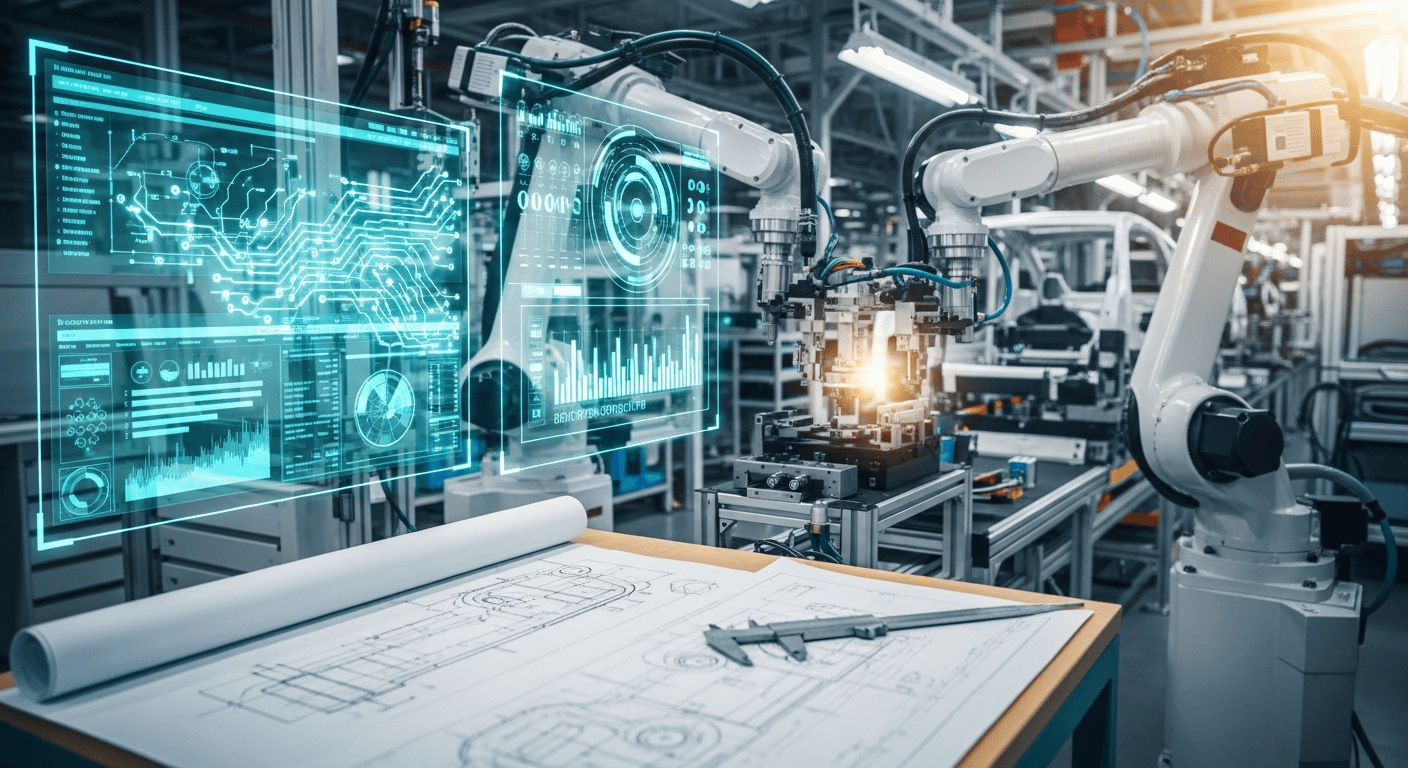
- Ford rehired 350 veteran “gray beard” engineers after its automated, AI-driven quality systems failed to deliver the quality the automaker expected.
- Ford’s VP of vehicle hardware engineering admitted the company “mistakenly” assumed that feeding design requirements into AI “would produce a high-quality product.”
- The reversal is projected to drive roughly $1 billion in cost reductions this year, and Ford topped the JD Power Initial Quality Survey for mainstream brands.
- New SignalFire data shows engineering was the most resilient tech job of 2025 — engineers made up 55% of new hires at 12 “Tech Majors,” up from 46% in 2019.
“Mistakenly we thought that by just introducing artificial intelligence and ingesting the design requirements that we had, that that would produce a high-quality product.” That admission — from Charles Poon, Ford’s vice president of vehicle hardware engineering — captures a quiet plot twist in the AI story. After leaning on automated, AI-driven quality systems and watching the results disappoint, Ford has hired back 350 veteran engineers. And it is not the only sign that the “AI will replace engineers” narrative is colliding with reality.
When AI Ran Quality Control, the Quality Slipped
The 350 veterans Ford quietly brought back
Ford executives said they hired 350 veteran engineers — some of them former employees, others who had been working at suppliers — after artificial intelligence and automated systems failed to deliver the quality level the company wanted. As Bloomberg first reported on June 25, chief operating officer Kumar Galhotra told journalists that Ford had been “relying more and more on automated quality systems” with disappointing results. So the company “brought back technical specialists,” and those specialists now “hunt for failure points before a part ever reaches the plant floor.”
Not anti-AI — AI with adult supervision
Crucially, Ford is not abandoning AI. The rehired engineers — the so-called “gray beards” — are being used to train younger staff and to reprogram the company’s AI tools, layering decades of hard-won domain expertise back on top of the automation. The payoff is already showing up on the balance sheet: Ford expects the move to contribute to roughly $1 billion in reduced costs this year, and the automaker just claimed the top spot among mainstream brands in the JD Power Initial Quality Survey released this week.
Trend Insight — The lesson is not “AI does not work.” It is that AI without deep domain expertise sitting on top of it produces confident-looking output that quietly fails exactly where it matters most. Ford’s fix was not less AI, but more human judgment wrapped around it.
The Data Nobody Expected: Engineering Is the Most Resilient Job
Hiring tells a different story than the layoffs
Ford’s reversal lands in the middle of a fierce debate over whether AI is already destroying jobs. Tech layoffs hit their highest single-month total in years this past May, and AI was the most-cited reason, according to outplacement firm Challenger, Gray & Christmas. Software engineering, in theory, should be the field most exposed to automation. Yet researchers at venture firm SignalFire say the hiring data points the other way. After tracking the careers of millions of employees across more than 80 million companies, SignalFire’s State of Talent Report 2026 concluded that engineering was the single most resilient job function in 2025.
The numbers behind the resilience
While total hiring across large tech companies dropped 25% compared with 2019 levels, engineering roles fell just 11%. In fact, engineers comprised 55% of all new hires in 2025 across the 12 companies SignalFire classifies as “Tech Majors” — Alphabet, Meta, Apple, Amazon, Microsoft, Netflix, Nvidia, Tesla, Uber, Airbnb, Block, and Stripe — a significant jump from 46% back in 2019. Early-stage startups leaned in even harder, bringing on 7% more engineers in 2025 than they did in 2019. “The rationale given for lots of layoffs is consistently AI,” said Asher Bantock, SignalFire’s head of research. “What we’re seeing on the ground is a little inconsistent with that.”
Trend Insight — Layoffs are loud, headline-grabbing, and conveniently blamed on AI. Hiring is quiet and harder to spin. When the two signals disagree, the hiring data — which reflects where companies actually place their bets — is usually the more honest indicator.
Why More AI Tends to Mean More Engineers, Not Fewer
The predictions were dramatic. Anthropic CEO Dario Amodei warned last year that AI could wipe out half of all entry-level white-collar jobs and push unemployment as high as 20% within five years. But Anthropic’s own head of economics, Peter McCrory, told TechCrunch in March that he had not yet seen significant AI-driven effects on the workforce, noting “there’s at least no larger material difference in unemployment rates” between workers who use AI for the most central tasks of their job — technical writers, data-entry clerks, software engineers — and workers in roles that demand physical dexterity in the real world.
The Jevons paradox comes for code
Nvidia CEO Jensen Huang went further still. Speaking at the Stanford Graduate School of Business in April, he flatly rejected the idea that AI will eliminate software jobs: now that every engineer at Nvidia uses agentic AI, “software engineers are busier than ever,” with agents writing code near-instantly and constantly pushing humans to generate “the next idea.” Economists have a name for this: the Jevons paradox — the observation that greater efficiency does not shrink demand for a resource, it expands it, because the work grows to fill the new capacity. As Bantock put it, engineers are “suddenly a lot more productive, and there’s endless work for them to do.”
Trend Insight — The bottleneck is shifting from writing code to deciding what to build and verifying that it is right. As AI absorbs the mechanical work, the scarce, valuable skill moves up the stack toward judgment, taste, and domain expertise.
What This Means If You Lead or Build With AI
For founders, CTOs, and developers watching their own AI bills and headcount, Ford’s story is a useful corrective. First, treat AI as an amplifier of expertise, not a substitute for it: the failure mode Ford described — plausible output that misses real-world failure points — is exactly what happens when models run without senior domain experts reviewing them. Second, build verification into the workflow, especially for quality- and safety-critical work; AI output is a fast first draft, not a finished part. Third, do not read the layoff headlines as the whole story. The hiring data shows demand for skilled builders is expanding, not collapsing, as tools get more capable.
The throughline across Ford, SignalFire, and Nvidia is the same: the organizations winning with AI are not the ones using the most of it or the least. They are the ones pairing AI’s raw throughput with human judgment — the 350 “gray beards” who know where a part will crack before it ever reaches the line. AI changed what engineers spend their time on. It did not, as it turns out, remove the need for them.
Trend Insight — The competitive edge in 2026 is not an AI strategy or a headcount-cut strategy. It is an integration strategy: deciding which decisions you hand to models, which you keep for experts, and how the two check each other’s work.
Related
- Your AI Coding Bill Tripled. Here’s Where Developers Went.
- Nvidia’s Real Moat Isn’t Chips. Qualcomm Just Paid $3.9B.
- OpenAI Finished Its Best Model. Then Washington Stepped In.
- Elon Just Paid $60 Billion to Catch OpenAI and Anthropic
- The $10 Billion Reason Nvidia Just Flew to Kazakhstan
Sources
- TechCrunch — Ford rehires ‘gray beard’ engineers after AI falls short (2026-06-28)
- Bloomberg — Ford Has Been Rehiring Quality Inspectors After AI Fell Short (2026-06-25)
- TechCrunch — AI was supposed to kill engineering jobs, but new data suggests they’re the most resilient (2026-06-24)
- SignalFire — State of Talent Report 2026
AI Biz Insider · AI Trends EN · aibizinsider.com
답글 남기기